Photo courtersy of Earthpod.com
A relative was recently diagnosed with Fibromyalgia and although I had heard the term in passing, I never really new what it was.
And recently it seems to be spoken of in great detail whether in medical journals or commercials that advertise treatments, so I decided to take a closer look.
According to medscape.com:
Fibromyalgia is a chronic syndrome that occurs predominantly in women and is marked by generalized pain, multiple defined tender points, fatigue, disturbed and nonrestorative sleep, and numerous other somatic complaints.
Fibromyalgia largely overlaps with other syndromes, such as Chronic Fatigue syndrome, Irritable bowel syndrome, temporomandibular joint pain. and multiple other regional pain syndromes, all of which feature symptoms that remain unexplained after usual clinical and laboratory assessment and all of which are related to, but not fully dependent on, depression and anxiety.
So does that clear things up for you? No? Me either. I mean as I try to categorize it, I need to know if it's bacterial or viral and is it hereditary? It would even help me more if I knew what could cause it. The fact is, the medical community does not have many of the answers I seek. According to medscape.com, Despite extensive research, no structural pathology has been identified in muscles or other tissues. Although psychological factors associated with chronic distress appear to be important for the development of fibromyalgia in many patients, abundant evidence now indicates that pain in fibromyalgia reflects abnormal pain processing in the central nervous system (i.e., central sensitivity). Clinically, fibromyalgia syndrome is best viewed from a biopsychosocial perspective encompassing multiple variables that contribute to chronic pain and fatigue.
Well, that helps a little but it still sucks because I need to figure this thing out.
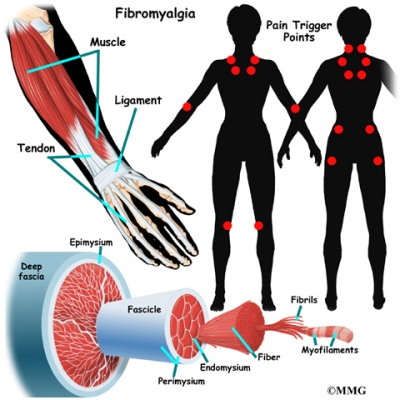
Oh well, lets move on to the symptoms. Pain is the hallmark of fibromyalgia. The pain extends from the skeleton and is confined in muscles and muscle-tendon connections in the neck, shoulders, hips, and extremities. And the pain is not one that can be ignored. The pain is usually accompanied by stiffness. Other symptoms include Fatigue and sleep disturbances,
Irritable bowel syndrome, Headaches and facial pain, Heightened sensitivity, Difficulty concentrating , Mood changes, Chest pain, Dry eyes, skin and mouth , Painful menstrual periods , Dizziness and Anxiety .
It was once thought that depression caused fibromyalgia pain, but now that it is a bit more understood, studies show that clinical depression can deepen a patients experience of pain. I also feel that because it is hard to diagnose (there is no single laboratory test that confirms it) that people who have it become frustrated as it takes numerous trips to the doctor's office and numerous blood tests and x-ray's to basically rule out other diseases before a doctor will consider performing a pressure point exam, and with this along with the medical tests and medical history make a diagnosis.
Is there a cure? Unfortunately no. Like most afflictions, the
symptoms are treated rather than a course of treatment that offers a cure given.
Analgesics and
Pregabalin are prescribed for pain,
Antidepressants to help promote sleep and
Muscle relaxants to treat muscle pain and spasms. The mayo clinic also offers these treatments that are considered
"alternative", Acupuncture, Chiropractic care, Massage therapy and Osteopathy.Suggested lifestyle changes include Reduce stress , Get enough sleep, Exercise regularly, Pace yourself , and Maintain a healthy lifestyle.
On the other end of the treatment spectrum is holistic or herbal medicines, and holisticonline.com offers these herbal treatments:
St. John's wort is a natural antidepressant and influences the adrenal gland hormones to help relieve stress. St. John's wort affects nerves and is effective for sharp, shooting nerve pains. It also has antiviral properties. (Caution: Do not take if you are taking conventional antidepressants.) Choose a standardized extract containing 0.3 percent hypericin and take 300 milligrams three times daily.
Siberian ginseng is an energizing herb that can help resolve the fatigue associated with fibromyalgia. Choose a standardized extract containing 0.5 percent eleutheroside E and take 100 milligrams twice daily, one-half hour before breakfast and lunch. After two weeks, you can gradually increase the dosage as needed. After six weeks, take one week off, then take the herb for another six weeks.
Turmeric helps to reduce pain and inflammation. Take 400 to 500 milligrams three times daily.
Cayenne, echinacea, goldenseal, astralagus, myrrh and chaparral boost the immune system and improve circulation. Combine them as a tea or tincture, It may be helpful to mix it with juice for better taste.
Calendula taken orally in high doses has a positive effect in reversing symptoms of fibromyalgia.
A combination of burdock, slippery elm, sheep sorrel and Turkish rhubarb was shown good results in improving fibromyalgia.
Garlic is useful for detoxification and to enhance immune system function. Take 5,000 mcg of standardized allicin three times daily. Kyolic, aged garlic is preferred.
Ginkgo biloba improves circulation and brain function.
Devil's claw root is a natural anti- inflammatory used to treat rheumatic disorders. Take one 400 mg devil's claw root tablet daily.
Willow bark has anti-inflammatory properties and works as a painkiller.
Passion flower, valerian and hops teas have sedating and muscle- relaxant properties.
Dong quai is good for fleeting muscle and joint pains, especially if they are worse in damp conditions. Take 1 capsule daily. For women only.
Licorice root acts in the body like cortisone, but without the harmful side-effects.
Milk thistle extract, artichoke, turmeric and dandelion supports liver function.
Dandelion reduces frequency and intensity of pain and strengthens the connective tissue. Take 1 tbsp. juice or 1 cup tea twice daily for four to six weeks.
Black walnut aid in removing parasites.
Paud'arco, taken in tea or tablet form, is good for treating candida infection.
Skullcap and valerian root improve sleep. Teas brewed from burdock root, dandelion, and red clover promote healing by cleansing the bloodstream and enhancing immune function. Combine or alternate these herbal teas, and drink 4 to 6 cups daily.
Topical applications of cayenne (capsicum) powder mixed with wintergreen oil can help relieve muscle pain. Cayenne contains capsaicin, a substance that appears to inhibit the release of neurotransmitters responsible for communicating pain sensations. Use 1 part cayenne powder to 3 parts wintergreen oil. Cayenne can also be taken orally, in capsule form.
Licorice root supports the glandular system. Caution: If overused, licorice can elevate blood pressure. Do not use this herb on a daily basis for more than seven days in a row. Avoid it if you have high blood pressure.
Pine-bark and grape-seed extracts are natural anti-inflammatories that help to ease pain. Take 50 milligrams of either two to three times daily.
Ginger Tea. Ginger is a good alternative to aspirin to relieve minor aches and pains. Steep 1 teaspoon of the grated root in 8 ounces of hot water for 10 minutes. Strain. Add honey for taste, if you like. Alternatively, take 1,000 to 2,000 milligrams of powdered ginger a day in capsule form with food.


